
New calendar (and financial year for some) is a familiar crossroads for businesses of all shapes and sizes. Sales and marketing leaders, business owners, and CFOs review and take stock to what is required to hit targets. Budgets, processes and outcomes are scrutinised. But there’s one area that’s easy to overlook even as it quietly expands in size and complexity: your company’s tech stack.
Just like holiday indulgence, business tools and data can accumulate quietly over the years. A few must try marketing apps here, new sales enablement tools there, client data stored on every team’s favourite platform, overlapping CRM add-ons, and so on. The intentions are good, boost efficiency, address new needs, react to the latest trends, or simply try what everyone’s raving about. But as you roll into Q1, that agile, lightweight stack may be looking a little bloated.
At Secret Source, we call this the “Tech Stack Diet” The same way you might decide to trim down after the holiday season, now is the perfect time for your business to tighten up its tech stack, shedding the inefficiencies, integrating your data, saving money (quite literally shedding the pounds, dollars, Euros), and preparing for lean, healthy growth in 2026.
This article will guide you through the “why, what, and how” of a tech stack audit. We’ll arm you with reference lists, actionable steps, and expert insights to ensure your tools are working for you, not the other way around.
1. Why Is Now A Good Time for a Tech Stack Audit
Just as individuals set New Year’s resolutions to get healthier, organisations often resolve to work smarter, not harder. The start of budgeting season, is the moment of truth:
- Financial Planning: Every tool you keep (or lose) impacts your budget for the coming year, critical for CFOs, business owners, and budget-holders, especially when markets are uncertain.
- Goal Realignment: Sales and marketing leaders must ensure that the systems in place support next year’s objectives, whether it’s revenue growth, pipeline transparency, or market expansion.
- Data Housekeeping: A clean slate is easier to maintain, auditing your data and tools now pays dividends when new strategies come into effect.
- Process Optimisation: Inefficiencies and duplicate processes are magnified as teams go for ambitious targets; slimming down your tech stack helps clear the path for new initiatives.
2. How the Modern Tech Stack Expands, and Why That’s a Problem
It’s never anyone’s plan to wind up with 15+ business apps and no clear idea of which one is the “real” source of truth. Here’s how the bloat happens:
Department-Led Initiatives
Modern teams move fast. Sales grabs a new call-tracking tool. Marketing onboards the latest AI-powered analytics platform. Customer service adds a chatbot. At the moment, these silos seem harmless, even helpful, but they create invisible islands of data.
FOMO (Fear of Missing Out)
Peer recommendations and industry buzz lead to experimenting with “the next big thing.” Leaders hesitate to standardise for fear of missing an edge, but soon, half the team is duplicating effort in two tools instead of one.
Lightweight Apps and Shadow IT
“Let’s just use this for now.” These stopgaps can become permanent fixtures, leading to hidden costs and compliance challenges.
Organic Growth, Patchwork Solutions
As companies expand, stacks evolve piecemeal, leading to disjointed workflows, redundant subscriptions, and multiple versions of the same customer record.
Key Takeaway: Each tool added without holistic review increases complexity, cost, and confusion.
3. The Hidden Costs of an Overweight Stack
So what does a bloated tech stack really cost your business? More than you think.
Financial Wastage
- Redundant subscriptions: Paying for licenses that do the same job, or never get used.
- Payment creep: Forgotten free trials becoming annual bills.
- Overprovisioning: Overbuilt (or underutilised) platforms bought just for one shiny feature.
Operational Inefficiencies
- Manual data transfers: Data re-keyed from one system to another.
- Version control headaches: Different departments running different versions of “the truth.”
- Consistent re-training: New team members have to learn multiple interfaces.
Poor Data Quality & Fragmentation
- Siloed databases: Data scattered across platforms.
- Duplicate records: Multiple, conflicting profiles for the same customer.
- Neglected or out-of-date data: “We’ll fix it later” until it’s too late.
Attribution and Reporting Issues
- Inconsistent metrics: Reporting platforms pulling non-matching numbers.
- Lost revenue opportunities: Inability to track leads, campaigns, or customer journeys accurately.
Risk Exposure
- Security liabilities: Unknown apps may lack proper security compliance.
- Business continuity: If key knowledge “lives” in one tool nobody else understands, what happens if that person leaves?
The Cost of NOT going on a tech stack diet include the following;
💳Hidden Cost😞Subscription Waste
📉Budget Drain, Overspending
🗂️Siloed Dataa
💡Poor Decision-Making, Lost Insights
🔀Duplication of Effort
📉Low Productivity, Staff Frustration
📊Reporting Chaos
📈Poor Attribution, Missed Revenue
🛡️Security Risk

Maybe it's time to shed the excess technology and start to use the TechStack that is actually good for you/business? Shape up in Q1-Q2 and start to reap the rewards. Starting is often the hard part.
What Are the Benefits of a Tech Stack Diet?
By deliberately reviewing and refining your tech stack, you turn clutter into clarity. Here’s what sales, marketing, finance, and operations leaders stand to gain:
Streamlined Operations
- Fewer systems to manage: Easier onboarding, better compliance, simplified training.
- Single source of truth: Unified data means better decision making and less confusion.
- Centralized workflows: Smoother processes, less hopping between tabs.
Improved Data Quality & Utilization
- Duplication cut-out: No more wasting time reconciling inconsistent records.
- Actionable insights: Confidence that your reports are accurate and up-to-date.
- Better AI performance: Machine learning works best with unified, high-quality data sets.
Financial and Resource Savings
- Lower software spend: No more paying for what you don’t use.
- Increased ROI: Every tool in the stack performs a critical role.
- Lean operations: Resources invested where they have the most impact.
Enhanced Agility and Competitive Edge
- Faster time to value: No more waiting on complex data pulls or reconciling platform outputs.
- Greater focus: Teams spend less time solving platform issues and more time on real business growth.
- Scalable infrastructure: Prepared to add or pivot tools that suit next year’s goals.

Like any good plan to improve, you need to have some short, medium and long term goals. Your TechStack is very similar. Like gym membership, you need to use your software subscription/functionality to get your monies worth. We all know that you need to listen to your gym instructor or dietian. Similarly, you need your RevOps Partner like Secret Source to show you the way. They do this for a iiving and know that is best for you and your organisation.Your RevOps Partner can help you reach your goals.
Tech Stack Diet Outcomes Checklist:
✅ Reduced costs
✅ Better data integrity
✅ Increased reporting accuracy
✅ Enhanced security
✅ More productive teams
✅ Ready for AI-powered efficiency
Common Challenges in Trimming Down: What to Expect
No healthy transformation is without its obstacles. A tech stack audit is no exception. Here’s what to watch for:
Change Resistance & Departmental Ownership
Department heads may be protective of their chosen platforms. There may be well-founded fear: losing unique workflows, custom data, or perceived control.
Solution: Open up the dialogue, make your audit process collaborative and emphasize shared goals. Demonstrating the wider benefits of standardization, combined with input from all stakeholders, works wonders.
Data Consolidation Nightmares:
Unifying different data sources can feel like untangling spaghetti. Here arte just some of the issues we typically see;
- Inconsistent Data Formats: Different systems might store similar types of data differently. Customer names might be in “First, Last” format in one system and “Last, First” in another, causing confusion and errors during consolidation.
- Siloed Data Pools: When departments have been using separate systems for years, integrating these data pools can uncover gaps where critical information might be missing or duplicated.
- Data Quality Problems: As you bring together data from various sources, you might encounter outdated, redundant, or inaccurate data that needs cleaning.
- Volume Overload: The sheer volume of data accumulated over the years can be overwhelming, making the task of consolidation time-consuming and resource-intensive.
Solution:
- Data Mapping and Cleansing: Start by mapping out where your data lives and identifying inconsistencies. Implement a thorough data cleansing process to eliminate duplicates and correct inaccuracies before consolidation.
- Choose the Right Tools: Utilize data integration tools that are designed to handle various data formats and can automate parts of the consolidation process. These tools often come with features that simplify data mapping and transformation.
- Establish a Single Source of Truth: Decide which system will serve as your primary repository for consolidated data. This central database should be the most up-to-date and accurate representation of your critical business information.
- Pilot and Iterate: Launch your consolidation efforts with a pilot project. Choose a manageable dataset to integrate first, use the learnings from this experience to refine your processes, and then expand to larger datasets.
By taking these steps, you can transform the daunting task of data consolidation into a streamlined process that lays a solid foundation for informed decision-making and strategic growth.
Integration Issues and Technical Hurdles:
Legacy systems that resist integration can be a real headache. You might encounter compatibility challenges, or find that some tools in your arsenal simply refuse to play nicely together.
Solution:
- Prioritize Integration-friendly Tools: When refining your tech stack, prioritize tools known for robust integration capabilities. Look for platforms that offer open APIs and strong customer support.
- Stagger the Transition: Implement changes in phases. This ensures continuity and allows you to troubleshoot potential issues without major disruptions.
- Leverage Expert Help: Don't hesitate to involve IT specialists or consultants to navigate particularly tricky integrations. Their expertise can save time and prevent costly errors.
Hidden Dependencies
Some tools might rely on others in your stack, and removing or replacing them could impact operations elsewhere.
Solution: Conduct a thorough dependency mapping before making any changes. Understand the upstream and downstream impacts of each tool and keep key stakeholders informed about any anticipated disruptions.
Underestimating Training Needs
Once new systems are in place, there’s a further challenge: ensuring your team knows how to use them effectively. Without adequate training, even the best tools can become obstacles rather than assets.
Solution:
- Plan Ahead for Training: Allocate time and resources for comprehensive training sessions. Ensure every team member is comfortable with the new tools.
- Create Supportive Documentation: Develop user guides and quick-reference sheets to help your team.
- Foster a Continuous Learning Environment: Encourage questions and ongoing learning to keep the team engaged and proficient.
Data Management: From Silos to Single Source of Truth
Transforming your tech stack means tackling data sprawl head-on. Here’s how to ensure every piece of data is accessible and relevant:
Centralize Your Data Platforms
Choose a primary platform that integrates well with others and can serve as your single source of truth. This cuts down on discrepancies and promotes uniformity across the board.
Ensure Continuous Data Hygiene
Regular checks and data cleansing processes help maintain accuracy and relevance over time.
Real-time Data Sync
Aim for platforms that update information in real-time, ensuring all teams work with current, accurate data. A well-structured, centralized data approach enhances decision-making and mitigates risks associated with outdated or disparate data.
Key Steps to a Successful Tech Stack Audit
Conducting a tech stack audit might seem daunting, but breaking it into manageable steps simplifies the process:
- Inventory Existing Tools: List all current tools, their purposes, costs, and integrations.
- Assess Performance: Identify which tools are essential, which overlap, and where there are gaps.
- Gather Feedback: Collect insights from users about tool efficacy and user experience.
- Define Clear Objectives: Align the tech stack with strategic business goals for the upcoming year.
- Plan Gradual Changes: Roll out changes in stages to minimize disruption.
- Measure and Iterate: Regularly review tech performance, gathering data to inform future decisions.
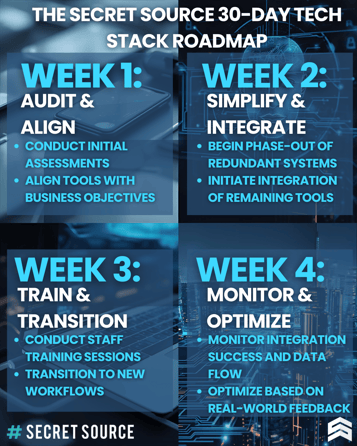
Secret Source’s 30-Day Tech Stack Diet: Our Get Fit for 2026 Plan
At Secret Source, we've created a 30-day roadmap to streamline your tech stack:
FAQs: Making It Happen
- How often should I audit my tech stack?
- At least annually, and consider smaller reviews quarterly.
- What should guide my choice of new tools?
- Alignment with business objectives, integration capabilities, and user feedback.
Conclusion
In the evolving business landscape of 2026, proactive tech stack management is a competitive advantage. A lean, integrated tech stack not only reduces costs but also enhances agility and efficiency, setting the stage for sustained growth.
Begin your tech stack audit today in Q1 and start looking after your future company.
Visitors also Read:
Read: The Night Your FrankenStack Stopped Making Sense and How to Fix It

We're qualified!
Secret Source don't just talk the talk, we can demonstrate live RevOps Projects all over the world. Come and start your journey by simply booking a meeting with one of our specialists today!