
Private equity firms face critical challenges when driving value creation in portfolio companies while navigating an increasingly complex marketing landscape. The stakes are high, and one vital element of growing a business, its marketing, if not done correctly can erode brand equity, waste capital, and delay exit timelines. However, done right then, strategic marketing investments and the right partners can accelerate growth, improve unit economics, and command premium valuations.
The Marketing Value Gap in Private Equity
Most PE firms excel at operational improvements, cost optimization, and strategic repositioning. Yet marketing often remains an overlooked lever for value creation. Portfolio companies frequently operate with outdated marketing strategies, siloed data systems, and teams lacking the expertise to capitalize on modern channels and technologies. While some business owners might even look for investment because they understand that their sales and marketing operation has lost momentum and needs re-invigorating.
This gap with marketing represents both risk and opportunity. Without proper marketing infrastructure, portfolio companies become vulnerable to competitive disruption, customer acquisition inefficiencies, and brand dilution. Conversely, firms that systematically improve marketing capabilities across their portfolios consistently achieve higher returns and more successful exits.
Core Protective Measures for Portfolio Company Marketing
PE and investment firms will attempt to fix some of these challenges in a variety of ways including;
-
Hiring a strategic marketeer to carry out due diligence and guide marketing efforts.
-
Hire consultants and marketing agencies across the different disciplines of the marketing mix.
-
Let the portfolio company itself hire and manage their own marketing team and agencies.
-
Acquire a marketing agency to work with different portfolio companies.
Secret Source have combined the above solutions, creating an accountable route for delivering growth through marketing. PE and investment firms that have embraced the RevOps business model are already realizing the benefits.
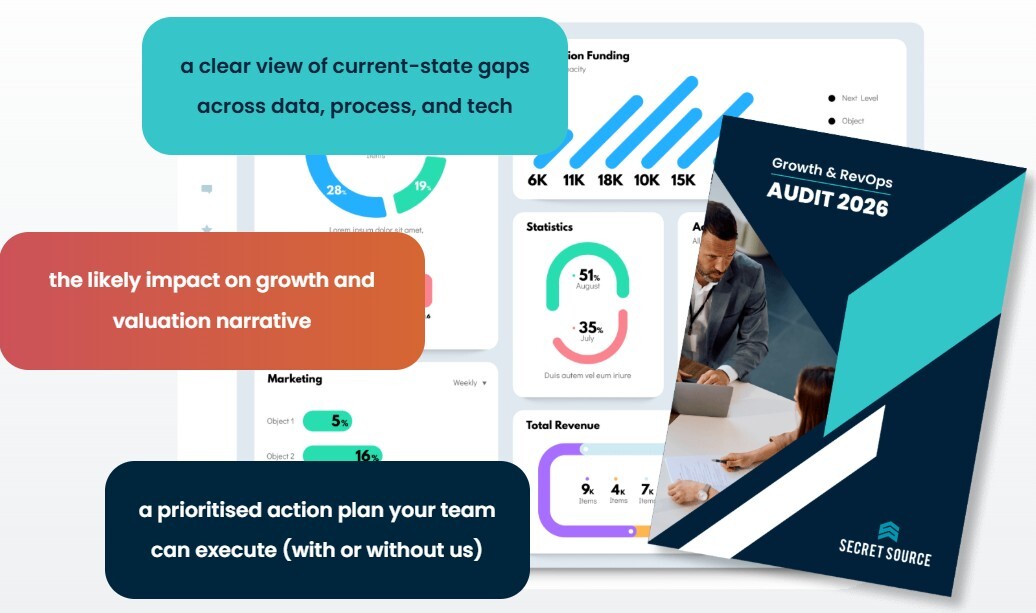
Let us reveal some 'secrets' our 'Source Teams' will use;
Establishing Marketing Governance and Accountability
Protection begins with structure. PE firms should implement clear marketing governance frameworks that include regular performance reviews, standardized KPI reporting, and defined approval processes for significant marketing investments. This doesn't mean micromanagement, but ensuring portfolio company leadership has the right talent, processes, and accountability mechanisms in place.
Carrying out weekly/monthly/quarterly marketing reviews that examine customer acquisition costs, lifetime value trends, brand health metrics, and competitive positioning. These sessions should identify early warning signs like rising acquisition costs, declining conversion rates, or emerging competitive threats.
Building Resilient Marketing Technology Infrastructure
Many portfolio companies operate with fragmented marketing technology stacks that create data silos, inefficiencies, and compliance risks. PE firms should conduct marketing technology audits early in the hold period to identify vulnerabilities around data privacy, marketing automation, analytics capabilities, and cross-channel attribution.
Investing in proper marketing infrastructure protects against several risks: regulatory penalties from data mishandling, wasted spend from poor attribution, and lost opportunities from inadequate customer insights. The goal isn't deploying the most expensive technology, it's ensuring systems work together cohesively and deliver actionable intelligence. Here are some case studies of this in practice.
Protecting Brand Equity During Transitions
M&A activity, leadership changes, and operational restructuring can destabilize brand equity if not managed carefully. PE firms should develop brand transition playbooks that outline how to communicate changes to customers, maintain brand consistency, and preserve customer relationships during periods of transformation.
This includes monitoring brand sentiment through social listening, maintaining consistent customer communication, and ensuring the marketing team has adequate resources during transition periods when they're often asked to do more with less.

Strategic Improvements That Drive Value
Implementing Data-Driven Marketing Frameworks
Moving portfolio companies from intuition-based to data-driven marketing creates sustainable competitive advantages. This means establishing proper measurement frameworks, implementing attribution modelling, and building testing cultures where marketing decisions are validated through experimentation rather than assumptions.
PE firms can accelerate this transformation by facilitating knowledge sharing across portfolio companies, bringing in specialized expertise for assessments, and ensuring marketing leaders have the analytical resources they need. Companies that master marketing analytics typically achieve 15-25% improvements in marketing efficiency within the first year. Secret Source assign a team member, with the skills and experience, to pick this up with directly with the investor partner and senior leadership teams (SLT) within the portfolio company assigned.
Modernizing Customer Acquisition Strategies
Many portfolio companies rely on legacy acquisition channels that are becoming less effective or more expensive. PE firms should push portfolio companies to diversify acquisition strategies, test emerging channels, and build owned audiences that reduce dependency on paid advertising.
This includes developing content marketing capabilities, building email and SMS subscriber bases, optimizing for organic search, and exploring partnership and affiliate channels. The goal is reducing customer acquisition costs while improving customer quality and lifetime value. While the different inputs and activities at the top of funnel marketing all depends on a number of variables within each use case, the mission is always clear for your Secret Source Team, working smarter with the budgets while competing within the marketplace for the market share with the right types of customers.
Leveraging AI and Automation
Artificial intelligence is transforming marketing efficiency and effectiveness. Portfolio companies should be deploying AI for personalization, predictive analytics, content generation, customer service automation, and campaign optimization. These technologies no longer require massive budgets, they're accessible to mid-market companies and deliver rapid ROI.
PE firms can protect portfolio companies from being left behind by ensuring they're experimenting with AI applications, training teams on emerging tools, and building AI literacy across marketing organizations.
However, AI still requires ownership to provide clear focus, compared to a scatter gun approach where everyone is using AI at an individual level to complete transactional tasks. This is where a Source Team member, specialising in AI, can be deployed to work across individual portfolio businesses. However while working with one business in the group they still appreciate the wider portfolio owned by your PE Firm. Collaboratively working with senior leaders within sales, marketing and service areas and helping to guide them on an overarching AI strategy. Need an AI Playbook for your portfolio businesses?
Building Marketing Talent and Capabilities
People remain the foundation of marketing effectiveness. PE firms should assess marketing talent early, identify capability gaps, and support portfolio companies in recruiting and developing high-performers. This might include facilitating access to fractional CMO resources, creating cross-portfolio training programs, or helping companies compete for talent against better-funded competitors.
Strong marketing leadership also needs adequate teams and budgets. Underinvesting in marketing talent is a common mistake that limits growth potential and makes companies less attractive to potential acquirers.
The secret behind the Secret Source model is that this can happen without delay. The right skills and experience working on your brand(s). Self-starting individuals already working together, combining their complementary skills to affect a result. Find out more.
Creating Cross-Portfolio Value
PE firms with multiple portfolio companies can create additional value through shared learning, vendor consolidation, and collaborative initiatives. Consider establishing marketing councils where portfolio company CMOs share insights, challenges, and best practices. Negotiate enterprise agreements with marketing technology vendors to reduce costs across the portfolio. Develop playbooks based on what's working across different companies and industries.
This collaborative approach accelerates improvement timelines and reduces the trial-and-error costs individual companies would incur learning independently.
Preparing for Exit Through Marketing Excellence
Strategic acquirers and public markets reward companies with strong marketing capabilities, defensible customer bases, and efficient growth engines. As portfolio companies approach exit, PE firms should ensure marketing functions demonstrate:
- Clear customer acquisition strategies with documented unit economics
- Diversified traffic and lead sources that reduce dependency risks
- Strong brand recognition and positive sentiment in target markets
- Modern marketing technology infrastructure
- Talented marketing leadership with retention agreements
- Data-driven decision-making cultures with robust analytics
These factors command premium valuations because they signal sustainable growth potential and reduced integration risks for acquirers.
Conclusion
Marketing represents both a significant risk and a powerful value creation lever for private equity firms. Protection comes through proper governance, infrastructure investment, and talent development. Improvement comes through data-driven frameworks, modern acquisition strategies, and AI adoption.
PE firms that systematically address marketing across their portfolios—not as an afterthought but as a core operational improvement priority—consistently achieve better returns. The firms winning in today's environment recognize that marketing excellence is essential for competitive survival and value maximization.
The question isn't whether to invest in portfolio company marketing capabilities, but rather how quickly you can implement systematic improvements that protect assets and accelerate value creation before your competitors do.
Secret Source have created a marketing growth checklist for the PE Firms that we work with. We tailor this to you, the types of portfolio companies and mission. If you wanted to discuss one for your PE Firm and indeed discover more secrets? Then follow us, subscribe or get in touch?

We're qualified!
Secret Source don't just talk the talk, we can demonstrate live RevOps Projects all over the world. Come and start your journey by simply booking a meeting with one of our specialists today!